e-moとは 意味・読み方・使い方
追加できません
(登録数上限)
意味・対訳 エモ;イーモ。emotion / emotional に由来する語。感情が揺り動かされるような、感情に訴えかけられるようなさま。
e-moの学習レベル | レベル:16 |
「e-mo」の部分一致の例文検索結果
該当件数 : 5件
The preventing layer 25 is formed by using an alloy made of any one or at least two of metals of Cr, Mo, Ni, Ti, Co, Ag, Au, Al, Pt, and Pd and any one of methods of a resistance heating method, a spatter method and an E-beam method.例文帳に追加
ショート防止層25は、Cr、 Mo、 Ni、 Ti、Co、Ag、Au、Al、Pt、Pdの金属のうち、何れか一つ又は少なくとも二つ以上からなる合金を使用し、抵抗加熱法、スパッタ法、E−ビーム法のうち、何れかの方法を使用して形成される。 - 特許庁
It has been considered that in ancient times there was a special distinction of the types of characters used for 14 sounds of エ, キ, ケ, コ, ソ, ト, ノ, ヒ, ヘ, ミ, メ, ヨ, ロ and モ (e, ki, ke, ko, so, to, no, hi, he, mi, me, yo, ro and mo) and their dull sounds if any.発音を聞く 例文帳に追加
エ・キ・ケ・コ・ソ・ト・ノ・ヒ・ヘ・ミ・メ・ヨ・ロ・モの14種および濁音がある場合はその濁音を古代特有の使い分けと見なしている。 - Wikipedia日英京都関連文書対訳コーパス
Ishizuka, in this book, concluded that there was a distinction in Manyo-gana, of the types of characters used for fifteen sounds, エ, キ, ケ, コ, ソ, ト, ノ, ヒ, ヘ, ミ, メ, ヨ, ロ, チ and モ (e, ki, ke, ko, so, to, no, hi, he, mi, me, yo, ro, chi, and mo).発音を聞く 例文帳に追加
この中で石塚は万葉仮名においてはエ・キ・ケ・コ・ソ・ト・ノ・ヒ・ヘ・ミ・メ・ヨ・ロ・チ・モの15種について用字に使い分けがあると結論づけた。 - Wikipedia日英京都関連文書対訳コーパス
It is known that among the 50-character syllabary used today, 14 sounds were written in two types of Manyo-gana, namely A-type and B-type, in ancient Japan before the Nara period, and this distinction of the types was strictly maintained; these 14 sounds were "キ, ヒ, ミ" (ki, hi, mi) with the vowel of イ (i), "ケ, へ, メ" (ke, he, me) with the vowel of エ (e), "コ, ソ, ト, ノ, (モ), ヨ, ロ" (ko, so, to, no, [mo], yo, ro) with the vowel of オ (o), and the vowel "エ" (e).発音を聞く 例文帳に追加
現代日本語の50音のうち、イ段のキ・ヒ・ミ、エ段のケ・へ・メ、オ段のコ・ソ・ト・ノ・(モ)・ヨ・ロ及びエの14音について奈良時代以前の上代には甲類と乙類の万葉仮名の書き分けが見られ、両者は厳格に区別されていたことがわかっている。 - Wikipedia日英京都関連文書対訳コーパス
According to "Saiguki" (exemplary book on Heian rituals), the ones dyed with a wave pattern (many were substituted by drawing) called 'suri-karaginu' (dyed karaginu) or 'kaibu-karaginu' (ocean pattern karaginu), and red mezome-mo (tie-dye clothes) were used for important ceremonies such as Sechi-e (seasonal court banquets), and this practice continued until the medieval period.発音を聞く 例文帳に追加
また、『西宮記』によると節会などの重い儀式には「摺唐衣」もしくは「海浦唐衣」とよばれる波の文様を摺った(描き絵の代用品も多い)ものと、赤い目染裳が用いられ、そのしきたりは中世まで継続した。 - Wikipedia日英京都関連文書対訳コーパス
-
履歴機能過去に調べた
単語を確認! -
語彙力診断診断回数が
増える! -
マイ単語帳便利な
学習機能付き! -
マイ例文帳文章で
単語を理解! -
Wiktionary英語版での「e-mo」の意味 |
emo
出典:『Wiktionary』 (2026/03/02 15:27 UTC 版)
発音
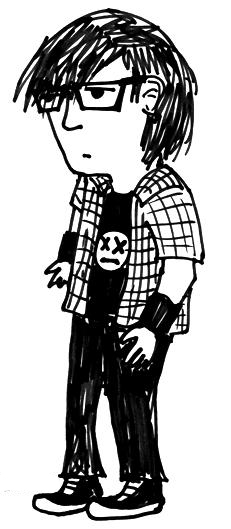

名詞
emo (countable and uncountable, plural emos)
- (uncountable, music) Any form of guitar-driven alternative rock that is particularly or notably emotional; a broadly encompassing genre of rock music characterized by expressive, often confessional lyrics. [late 1990s-current]
- (music, historical) A subgenre of late 1980s hardcore punk originating in Washington D.C., characterized by intense, highly emotional performances, dynamic shifts, and a departure from traditional punk song structures (also emocore). [early 1990s]
- (music, by extension) A 1990s indie rock movement characterized by complex guitar work (often borrowing from math rock), dynamic shifts, arpeggiated melodies, and deeply introspective lyrics; commonly referred to as Midwest emo. [1990s]
- (music) A commercially successful 2000s alternative rock and pop-punk movement characterized by theatricality, melancholic, or romantically frustrated themes, and highly polished production. [2000s]
- (music, derivative) Electronic-infused subgenres incorporating aggressive, satirical, or hedonistic themes layered over post-hardcore or pop-punk foundations (e.g., crunkcore, neon pop-punk). [late 2000s]
- (countable) An individual presenting as such.
- (countable) A person associated with that subculture and musical style. [early 1990s]
- (countable) A person associated with a fashion or stereotype of that style of rock. [late 1990s-current]
- A participant in the heavily aestheticized 2000s and 2010s subculture.
- (countable) (by extension) A typically young individual whose outward persona is characterized by introspection, sensitivity, melancholy, or angst; considered to be overly emotional or who is associated with the emo subculture. [2000s]
- (countable, by extension, derogatory) Sometimes used pejoratively to imply inauthenticity (poser) or used ironically to denote exaggerated teenage rebellion.
- (countable) A person associated with that subculture and musical style. [early 1990s]
形容詞
emo (comparative more emo, superlative most emo)
- Associated with youth subcultures which are associated with the above-mentioned musical genre(s) and with emotional sensitivity.
- (informal, loosely, often derogatory) Emotional, sensitive, or contemplative; regardless of musical preference or subcultural affiliation.
- (informal, loosely, by extension) Depressed.
-
2008, Vanity Fair, number 578:
-
Criticism drapes a black velvet cape across the puddle that interrupts the path to change, to be emo about it.
-
-
- (fashion, aesthetic) Exhibiting a fashion or visual aesthetic associated with the subculture; a presentation deliberately or unintentionally incorporating dark clothing, asymmetrical haircuts covering one eye, studded accessories, and often borrowing elements from gothic fashion, Burtonesque macabre, or brightly colored scene or geek aesthetics.
-
Hot Topic is historically recognized as the go-to mall emo store, particularly during the 2000s, serving as a primary hub for alternative, scene, and punk fashion, music merch, and accessories like studded belts.
-
派生語
使用する際の注意点
- Not to be confused with the socio-political rebellion of punk or the romanticized, atmospheric macabre of goth, emo is distinctly characterized by its focus on internal, confessional vulnerability and personal emotional anguish.
- The term is heavily contested due to its semantic shift; purists often restrict the definition to 1980s and 1990s underground movements), however, common linguistic usage firmly embraces senses validating the 2000s mall emo or general emotionality as legitimate definitions.
- The term has evolved dramatically. It began with the unassuming, casual geek aesthetic of the 1990s (thick-rimmed glasses, sweater vests); by the mid-2000s, it absorbed heavily stylized, gothic-lite, and macabre elements (eyeliner, black dyed hair); by the late 2000s, it splintered into the scene aesthetic, which combined the core emo silhouette with neon colors, tongue-in-cheek irony, and internet culture.
- In the late 2000s, emo was frequently used as a pejorative term to mock teenagers who were perceived as melodramatic or attention-seeking; in the 2020s, with the rise of nostalgia, the term has been largely reclaimed by millennials and Gen Z as a badge of honor, often used ironically or affectionately to describe both themselves and the music of their youth.
語源
From Proto-Italic *emō, from Proto-Indo-European *h₁em- (“to take, distribute”), with excrescent p in ēmptum. The origin of the perfect form is slightly more convoluted. According to De Vaan and Rix, it may have originated from a Proto-Indo-European reduplicated stative form. However, the origin of Latin long-vowel perfects is generally disputed, and other linguists suggest it may have derived from a Narten-type present. Numerous related verbs such as sūmō or dēmō have a perfect stem ending in -psī. De Vaan argues that these new stems are innovative, and were formed after these related verbs had become synchronically unidentifiable with emō.
Cognate with Lithuanian im̃ti, Old Church Slavonic имѫ (imǫ) and possibly Old Armenian իմանամ (imanam). Possibly related to Proto-Indo-European *nem- (“to take or give one's due”), with its descendants English nim, Danish nemme, Dutch nemen, German nehmen, West Frisian nimme, Ancient Greek νέμω (némō).
発音
- (Classical Latin) IPA: [ˈɛ.moː]
- (modern Italianate Ecclesiastical) IPA: [ˈɛː.mo]
動詞
emō (present infinitive emere, perfect active ēmī, supine ēmptum or ēmtum); third conjugation
- (transitive) to buy, purchase
- (figuratively) to acquire, procure
Conjugation
At least one use of the Old Latin "sigmatic future" and "sigmatic aorist" tenses is attested, which are used by Old Latin writers; most notably Plautus and Terence. The sigmatic future is generally ascribed a future or future perfect meaning, while the sigmatic aorist expresses a possible desire ("might want to").
派生語
派生した語
- ⇒? Vulgar Latin: *disemere
- Asturian: disimir
参照
- “emo”, in Charlton T. Lewis and Charles Short (1879), A Latin Dictionary, Oxford: Clarendon Press
- “emo”, in Charlton T. Lewis (1891), An Elementary Latin Dictionary, New York: Harper & Brothers
- “emo”, in Gaffiot, Félix (1934), Dictionnaire illustré latin-français, Hachette.
- Carl Meißner; Henry William Auden (1894), Latin Phrase-Book, London: Macmillan and Co.
- De Vaan, Michiel (2008), Etymological Dictionary of Latin and the other Italic Languages (Leiden Indo-European Etymological Dictionary Series; 7), Leiden, Boston: Brill, →ISBN, page 188
- Rix, Helmut, editor (2001), Lexikon der indogermanischen Verben [Lexicon of Indo-European Verbs] (in German), 2nd edition, Wiesbaden: Dr. Ludwig Reichert Verlag, →ISBN, page 236
- Sihler, Andrew L. (1995), New Comparative Grammar of Greek and Latin, Oxford, New York: Oxford University Press, →ISBN, page 581
- Jasanoff, Jay (2012), “Long-Vowel Preterites in Indo-European”, in Melchert, C., editor, The Indo-European Verb, pages 2-3
- Leppänen, Ville (2019), Ablaut and the Latin Verb: Aspects of Morphophonological Change (PhD Dissertation), Munich: Ludwig Maximilian University of Munich, , pages 34-35
ウィキペディア英語版での「e-mo」の意味 |
Emo
出典:『Wikipedia』 (2011/05/08 09:21 UTC 版)
Weblio例文辞書での「e-mo」に類似した例文 |
|
e-mo
電子郵便.
Eメールログ
a mail van
the east
The Martian
moas
a request
emo
a soul
a desire
a desire
気の弱い.
|
|
|
e-moのページの著作権
英和・和英辞典
情報提供元は
参加元一覧
にて確認できます。
| Copyright © 2026 CJKI. All Rights Reserved | |
|
Text is available under Creative Commons Attribution-ShareAlike (CC-BY-SA) and/or GNU Free Documentation License (GFDL). Weblio英和・和英辞典に掲載されている「Wiktionary英語版」の記事は、Wiktionaryのemo (改訂履歴)の記事を複製、再配布したものにあたり、Creative Commons Attribution-ShareAlike (CC-BY-SA)もしくはGNU Free Documentation Licenseというライセンスの下で提供されています。 |
|
|
Text is available under Creative Commons Attribution-ShareAlike (CC-BY-SA) and/or GNU Free Documentation License (GFDL). Weblio英和・和英辞典に掲載されている「Wikipedia英語版」の記事は、WikipediaのEmo (改訂履歴)の記事を複製、再配布したものにあたり、Creative Commons Attribution-ShareAlike (CC-BY-SA)もしくはGNU Free Documentation Licenseというライセンスの下で提供されています。 |
|
| CMUdict | CMUdict is Copyright (C) 1993-2008 by Carnegie Mellon University. |
ピン留めアイコンをクリックすると単語とその意味を画面の右側に残しておくことができます。 |
|
ログイン |
Weblio会員(無料)になると
|
「e-mo」のお隣キーワード |
weblioのその他のサービス
|
ログイン |
Weblio会員(無料)になると
|